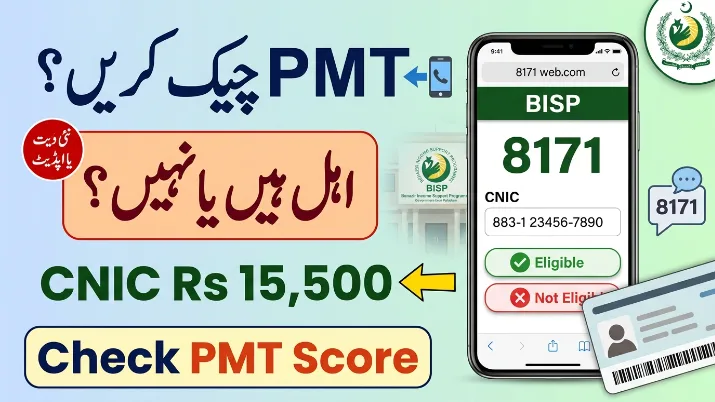
8171 PMT Score Check: A Complete Guide to Verifying Your BISP Eligibility
Millions of families across Pakistan rely on timely access to government support, and one of the first things they want to know is simple: how do I check my 8171 PMT score, and what does it actually mean for my household? If you’ve heard people talking about the 8171 PMT score check but aren’t sure how the process works or why your status keeps changing, this guide breaks it down in plain language, without the confusion that usually surrounds it.
In short, the PMT score check 8171 system lets you find out whether your household qualifies for financial assistance under the Benazir Income Support Programme by entering your CNIC number through the official channel. A lower score generally means a higher chance of qualifying, while a higher score can mean reduced support or no support at all. The rest of this article walks through exactly how that score is calculated, how you can check it yourself, and what to do if something doesn’t look right.
What Is the PMT Score and Why Does It Matter
PMT stands for Proxy Means Test. It’s not a credit score or a bank rating, it’s a poverty assessment tool used to estimate how financially stable a household actually is, based on indicators collected through Pakistan’s National Socio-Economic Registry, commonly shortened to NSER.
Instead of just looking at your monthly income (which can be unreliable or hard to verify in an informal economy), the PMT model looks at a wider basket of signals. Things like the type of house you live in, whether you own land or a vehicle, how many earning members are in the household, access to utilities, and overall living conditions all feed into the final number.
The logic is straightforward once you see it laid out: families showing fewer assets and weaker living conditions tend to receive a lower PMT score, which puts them closer to qualifying for support. Families with comparatively stronger financial indicators, even small ones like a newly built brick house or a recently purchased motorbike, can see their score rise enough to affect their eligibility.
How the 8171 PMT Score Check Actually Works
The 8171 system is essentially a digital front door to your NSER record. When you check your status through it, you’re really asking the database one question: does this household’s current PMT score fall under the eligibility threshold for BISP programs?
Here’s what typically happens behind the scenes when you submit your CNIC:
- The system pulls your most recent NSER survey record linked to that CNIC
- It compares your current PMT score against the cutoff used for the specific program (Benazir Kafaalat, Taleemi Wazaif, or emergency relief)
- It returns a status, usually shown as “eligible” or “ineligible,” along with basic payment details if applicable
- In most cases the exact numeric score isn’t displayed publicly, only the outcome
That last point trips a lot of people up. The portal is built to give a clear answer rather than a raw number, so if you want your literal PMT score figure rather than just a yes or no, you’d need to visit your nearest BISP Tehsil office and ask the staff there directly.
Step by Step: Checking Your PMT Score Online
Checking your status doesn’t require any technical skill, and it shouldn’t take more than a couple of minutes if the portal is responding normally. You’ll need your 13-digit CNIC number, entered without dashes, and a working internet connection.
Once you’re on the correct page, you enter your CNIC, complete the CAPTCHA verification, and submit the form. The system then displays your current eligibility status. If you’re marked eligible, you’ll usually also see basic information about your next expected payment cycle.
For people without reliable internet access, there’s a simpler backup option. You can send your CNIC number as a text message to the designated 8171 SMS shortcode, and you’ll receive a reply indicating your eligibility status. It’s worth sending it from a SIM that’s actually registered under your own CNIC, since mismatched registrations sometimes cause delays or unclear replies.
Understanding the Score Ranges
This is where a lot of confusion creeps in, because the thresholds genuinely sound technical even though the underlying idea is simple: lower score, higher chance of help.
| PMT Score Range | What It Generally Means |
|---|---|
| 0 to 32 | Considered highly eligible for quarterly Benazir Kafaalat cash assistance |
| 32 to 40 | May qualify for education-linked support such as Taleemi Wazaif, or partial assistance |
| Above 40 | Typically considered ineligible for most BISP cash transfer programs |
It’s worth being honest here: these ranges can shift slightly depending on policy updates, regional cost-of-living adjustments, and budget allocations in a given year, so treat them as a general guide rather than a fixed rule carved in stone.
Why Your PMT Score Might Have Changed
This is probably the question people ask most often, especially when a payment that used to arrive regularly suddenly stops. There’s rarely one single cause, but a few patterns show up again and again.
A new job in the household, even a modest one, can shift the numbers enough to cross the threshold. So can visible property improvements, like converting a mud structure into a cemented house, or buying a motorcycle that gets recorded during a survey update. Sometimes it’s not even a real change in circumstances at all, it’s simply that the household’s NSER data hadn’t been updated in years and the new survey reflects information that’s actually outdated or slightly inaccurate.
Biometric verification issues and expired CNICs are another common, less dramatic reason. If your identity verification fails at a payment point, the system can flag your file even if your actual financial situation hasn’t changed at all.
What to Do If You’re Marked Ineligible
Finding out you’re ineligible after expecting support can be frustrating, but there is a clear path forward if you believe the result doesn’t reflect your real situation. The first step is visiting your nearest BISP Tehsil office in person rather than relying only on the online portal, since staff there can pull your detailed record and explain exactly which factors pushed your score up.
From there, you can request a Dynamic Registry update, which essentially refreshes your household’s survey data. This matters because PMT scores aren’t recalculated constantly, they’re typically reviewed every two to three years unless you specifically request an update sooner. If your circumstances have genuinely worsened since your last survey, an updated record can correct your eligibility status.
It’s also worth repeating something BISP itself has emphasized publicly: all verification and registration services are free. If anyone asks for money to “fix” your score or speed up an application, that’s not how the official system works, and it’s reasonable to be cautious.
Final Thoughts
The 8171 PMT score check is ultimately a tool for transparency, even if the underlying calculation feels a bit like a black box from the outside. Understanding what factors influence the score, checking your status periodically rather than waiting for a payment to fail, and keeping your NSER survey information current are the most practical ways to avoid unexpected disruptions. If something does go wrong, the fix usually isn’t complicated, it just requires showing up at the right office with the right documents.
Frequently Asked Questions
What does a good PMT score actually look like?
People often expect a “good” score to be a high number, since that’s how most scoring systems work, but it’s the opposite here. A lower number is what you want, and anything sitting comfortably under the standard cutoff is generally treated as a strong indicator that a household qualifies for ongoing support.
Can I see my exact PMT score number online?
Not usually. The web portal is designed to give you a status rather than a raw figure, so most users only see “eligible” or “ineligible.” If you specifically need the number itself, that typically means a trip to your local BISP office where staff can look up the figure tied to your NSER file.
Why did my BISP payment stop without any warning?
There’s almost never just one trigger. It could be a score change from an updated survey, a biometric mismatch, an expired identity document, or even a household member’s recent income or asset change being picked up in a fresh registry update. Checking your status through the portal is usually the fastest way to get a starting answer.
Is there a fee for checking eligibility or updating my survey?
No. Every official step in this process, from the CNIC check to the dynamic survey update at a Tehsil office, is provided free of charge by the government. Anyone requesting payment for these services isn’t operating through the legitimate channel.
How often does the PMT score get recalculated?
Generally every two to three years, tied to a fresh NSER survey cycle, though a household can request an earlier update if its financial situation has changed significantly, for better or worse, and needs to be reflected sooner.